
If you've spent any time researching NAATI, you've probably encountered both the words "certification" and "accreditation" — often seemingly used interchangeably. They are not the same thing, and understanding the difference matters, especially if you're ordering a certified translation or considering a career as a translator or interpreter.
Here is a clear explanation of what each term means in the NAATI context.
A Brief History: Why the Terminology Changed
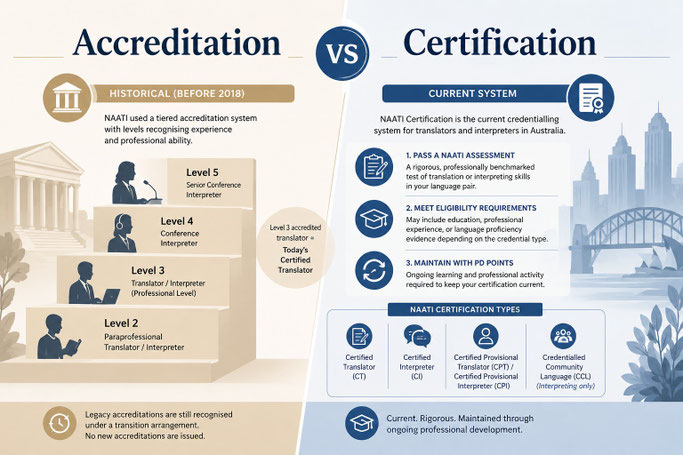
For decades, NAATI used the term "accreditation" to describe its credentialling system. A "NAATI-accredited translator" was the standard way to refer to someone who had passed NAATI's assessment and was authorised to produce certified translations accepted by Australian government agencies.
In 2018, NAATI overhauled its entire credentialling framework and introduced a new system based on certification rather than accreditation. The old accreditation system was retired, and the new system launched under the name NAATI Certification.
This is why you may see older documents or websites referring to "NAATI-accredited translators" — they are simply using pre-2018 terminology. In contemporary usage, the correct term is "NAATI-certified."
What Is NAATI Certification?
NAATI Certification is the current credentialling system for translators and interpreters in Australia. To obtain certification, a candidate must:
- Pass a NAATI assessment in their language pair — a rigorous, professionally benchmarked test of translation or interpreting skills.
- Meet additional eligibility requirements, which may include education, professional experience, or language proficiency evidence depending on the credential type.
- Maintain their certification through a Professional Development (PD) points system, which requires ongoing learning and activity to keep their credential current.
NAATI offers several types of certification, the most relevant for general translation work being:
- Certified Translator (CT) — for written translation
- Certified Interpreter (CI) — for spoken interpreting
- Certified Provisional Translator (CPT) / Certified Provisional Interpreter (CPI) — entry-level certifications
For Chinese↔English practitioners, there is also the well-known Credentialled Community Language (CCL) — though this is specifically for interpreting contexts, not full professional certification.
What Was NAATI Accreditation (Historical)?
Before 2018, NAATI used a tiered accreditation system with levels including:
- Level 2 (Paraprofessional Translator/Interpreter)
- Level 3 (Translator/Interpreter — the main professional level)
- Level 4 (Conference Interpreter)
- Level 5 (Senior Conference Interpreter)
A "Level 3 accredited translator" was the equivalent of what today would be a Certified Translator. Many experienced translators and interpreters still hold legacy accreditations, which NAATI has allowed to continue under a transition arrangement — but new accreditations under the old system are no longer issued.
How Do the Terms Overlap in Everyday Usage?
Even though NAATI moved away from "accreditation" in 2018, the word has not disappeared:
- Many clients and agencies still say "NAATI-accredited" out of habit, even when they mean "NAATI-certified."
- Some government websites and legal documents may still use the older terminology.
- The phrase "NAATI accreditation" is still commonly used as a synonym for "NAATI certification" in informal contexts.
In practice, if someone says "I need a NAATI-accredited translation," they almost certainly mean a translation produced by a currently NAATI-certified translator. What matters when ordering a translation is that the translator holds a current, valid NAATI credential — regardless of whether it is described as "certification" or "accreditation."
What About the CCL (Credentialled Community Language)?
The CCL (Credentialled Community Language) is a separate NAATI credential aimed primarily at immigration officers, settlement workers, healthcare staff, and others who use their non-English language professionally in a community context. It is not a translation or interpreting certification in the full professional sense.
The CCL is commonly relevant in the context of the SkillSelect immigration points test, where applicants can earn extra points for holding a CCL credential. However, a CCL-credentialled person cannot produce NAATI-certified translations — that requires a Certified Translator (CT) credential.
Why Does This Matter When Ordering a Translation?
When you order a certified translation for immigration, legal, or official purposes, you need a translation produced by a Certified Translator (CT) — or a translator holding an equivalent legacy NAATI accreditation. Neither a CCL credential nor general bilingual ability is sufficient.
To verify that a translator holds the correct credential:
- Ask for their NAATI Practitioner ID (CPN).
- Search their name or CPN at www.naati.com.au using the Verify a Credential tool.
- Confirm that their credential type is Certified Translator (or an equivalent legacy accreditation).
Summary
- "Accreditation" is NAATI's pre-2018 terminology; "certification" is the current term. They describe the same type of professional credential.
- A Certified Translator (CT) is the current standard for producing official certified translations accepted by Australian government agencies.
- The CCL credential is not a translation credential — it does not authorise the holder to produce certified translations.
- When ordering a translation, always verify the translator's current NAATI credential at naati.com.au.
At Lingofish Translation Services, Jiang Yu holds a current NAATI Certified Translator credential (Practitioner ID: CPN0EV36J) for English↔Chinese. You can verify this directly at www.naati.com.au. We translate PRC Chinese documents, TW/HK/MO documents, and Australian documents. Get a free quote or contact us today.
Frequently Asked Questions (FAQ)
Q: Are "NAATI-certified" and "NAATI-accredited" the same thing?
A: In everyday conversation, yes — they are used interchangeably. Technically, "accreditation" is pre-2018 NAATI terminology and "certification" is the current term. Both refer to credentials issued by NAATI that authorise a translator or interpreter to work professionally in Australia.
Q: Can someone with a CCL credential produce a certified translation?
A: No. The CCL (Credentialled Community Language) is not a translation or interpreting certification. It does not authorise the holder to produce certified translations accepted by Australian government agencies.
Q: Does NAATI still issue accreditations?
A: No. NAATI stopped issuing new accreditations under the old system in 2018. The current system is called certification. Translators and interpreters who were previously accredited may still hold valid legacy credentials under a transition arrangement.
Q: What type of NAATI credential do I need for a certified translation?
A: You need a translation produced by a Certified Translator (CT) or a person holding an equivalent legacy NAATI accreditation. You can verify this at naati.com.au using the Verify a Credential tool.
Q: What is the difference between a Certified Translator and a Certified Provisional Translator?
A: A Certified Provisional Translator (CPT) is an entry-level certification for translators who have demonstrated competence but have less experience than a fully certified translator. Both can produce certified translations, though some institutions may specify a particular level.
References:
- NAATI Certification Overview: https://www.naati.com.au/certification/
- NAATI Certified Translator credential: https://www.naati.com.au/certification/translators/certified-translator/
- NAATI CCL credential: https://www.naati.com.au/certification/ccl/