
If you've received a NAATI-certified translation by email and wondered whether a home printout qualifies as a legitimate certified copy, you're not alone. This is one of the most common questions we hear from clients preparing visa applications and immigration documents in Australia.
The short answer: yes, a printout of a NAATI digital stamp translation is a fully valid certified copy — accepted by the Department of Home Affairs, DFAT, and other Australian government agencies. Here's exactly why, with references to official NAATI sources.
What Is a NAATI Digital Stamp?
In March 2023, NAATI (the National Accreditation Authority for Translators and Interpreters) officially introduced the NAATI Digital Stamp for certified translators. This was developed in response to feedback from practitioners who previously had to print every page of a translation, apply a physical ink stamp, sign it by hand, scan the whole document, and then email it to the client — a slow and cumbersome process.
The digital stamp solves this by generating a downloadable PNG image file that the translator inserts directly into the electronic document. Each digital stamp contains:
- The translator's full name
- Their NAATI Practitioner ID
- Their certified language pair and credential type
- The date the stamp was generated
- The text "Digitally Authenticated by NAATI"
- A QR code that links directly to NAATI's credential verification tool at www.naati.com.au
Because the stamp is unique to each translator and each credential period, it is significantly more secure than a traditional ink stamp — a physical stamp image can be photographed and misused, whereas the digital stamp's QR code is verifiable in real time.
Can You Print a Document with a Digital Stamp?
Yes. NAATI's official FAQ explicitly states:
"Is the digital stamp to be used on digital deliveries only? What about physical copies of translations? You can apply the digital stamp and print the document if needed." — NAATI FAQ, www.naati.com.au/resources/faq/
This means that when a translator delivers a translation as a PDF or Word document bearing the NAATI digital stamp, and you print that document at home or at a print shop, the printout carries the same legal weight as a document bearing a traditional physical (wet) ink stamp.
Why Is the Printout Valid?
The validity comes from the stamp itself — not the medium on which it is printed. The NAATI digital stamp:
- Identifies the certified translator beyond doubt, via their Practitioner ID and name.
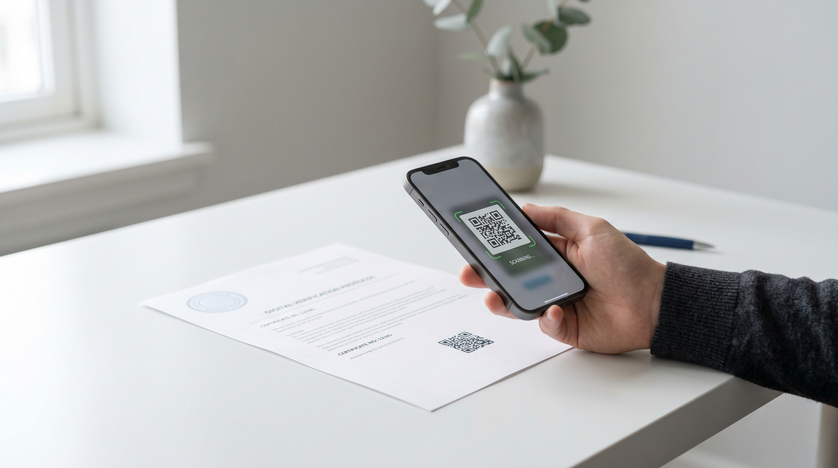
- Can be verified by anyone at any time by scanning the QR code, which displays the translator's credentials on the NAATI website.
- Is officially recognised by Australian government agencies including the Department of Home Affairs and the Department of Foreign Affairs and Trade (DFAT).
According to DFAT's official requirements for translators, a translation submitted to DFAT must include the translator's NAATI stamp — either physical or digital — clearly showing the practitioner ID, language and certification type, translator's name, and either a handwritten signature (physical stamp) or the text "Digitally Authenticated by NAATI" (digital stamp). DFAT explicitly treats both formats as equally valid.
Which Agencies Accept the Digital Stamp Printout?
The Department of Home Affairs accepts digital NAATI translations — and therefore printouts of those translations — for virtually all visa applications lodged through ImmiAccount, including:
- Partner visas (subclass 820/801, 309/100)
- Skilled migration visas (subclass 189, 190, 491)
- Student visas (subclass 500)
- Family and humanitarian visas
- Citizenship applications
As a general rule, if the receiving organisation accepts NAATI-certified translations, they will accept a printout of a digitally stamped translation.
How to Verify the Stamp on Your Printout
If you — or the organisation receiving your translation — wishes to verify the stamp:
- Scan the QR code printed on the document using any smartphone camera.
- You will be directed to the NAATI website where the translator's credentials are displayed.
- Alternatively, visit www.naati.com.au and use the "Verify a Credential" tool on the homepage, entering the translator's Practitioner ID.
This verification works even after the translator's credential renewal date has passed — translations do not expire.
A Note on Fraud Prevention
One of the reasons NAATI developed the digital stamp was to combat fraud. Previously, scanned images of physical stamps were sometimes "photoshopped" onto fraudulent translations. The digital stamp's QR code is tied to the specific translator and can be verified against NAATI's live database, making this kind of fraud significantly harder to perpetrate.
Summary
- A NAATI digital stamp on a translation is fully official and legally recognised.
- Printing a document bearing a NAATI digital stamp creates a valid certified physical copy.
- The QR code on the printed document can be scanned to verify the translator's credentials at any time.
- This format is accepted by the Department of Home Affairs, DFAT, and other Australian government agencies.
At Lingofish Translation Services, all certified translations are delivered as PDFs bearing the official NAATI digital stamp. You can print your translation with confidence that it will be accepted wherever a NAATI-certified translation is required. We translate PRC Chinese documents, TW/HK/MO documents, and Australian documents. Visit lgtranslation.com to get started.
Frequently Asked Questions (FAQ)
Q: Is a printed NAATI digital stamp translation accepted by the Department of Home Affairs?
A: Yes. The Department of Home Affairs accepts NAATI-certified translations bearing the digital stamp — and printouts of those translations — for all standard visa and immigration applications lodged through ImmiAccount.
Q: Does a NAATI-certified translation expire?
A: The translator's NAATI credential is renewed periodically, but the translation itself does not expire. The QR code on a printout remains verifiable even after the translator's renewal date.
Q: How do I verify the NAATI digital stamp on a printed translation?
A: Scan the QR code on the document with any smartphone camera. You'll be taken to the NAATI website showing the translator's verified credentials in real time. Alternatively, use the Verify a Credential tool at naati.com.au.
Q: Can I submit a digital (PDF) translation without printing it?
A: For most online applications (e.g., ImmiAccount), yes — you can upload the PDF directly. Printing is only necessary when a physical copy is specifically required by the receiving organisation.
Q: What is the difference between a NAATI digital stamp and a physical ink stamp?
A: Both are equally valid under Australian law and DFAT requirements. The digital stamp includes a QR code for instant online verification, making it more secure against forgery than a traditional ink stamp.
References:
- NAATI Digital Stamp and ID: https://www.naati.com.au/news/naati-digital-stamp-and-id/
- NAATI FAQ — Digital Stamps: https://www.naati.com.au/resources/faq/
- NAATI Practitioner Identification: https://www.naati.com.au/resources/naati-practitioner-identification/
- DFAT Requirements for Translators: https://www.naati.com.au/resources/dfat-translation-requirements/